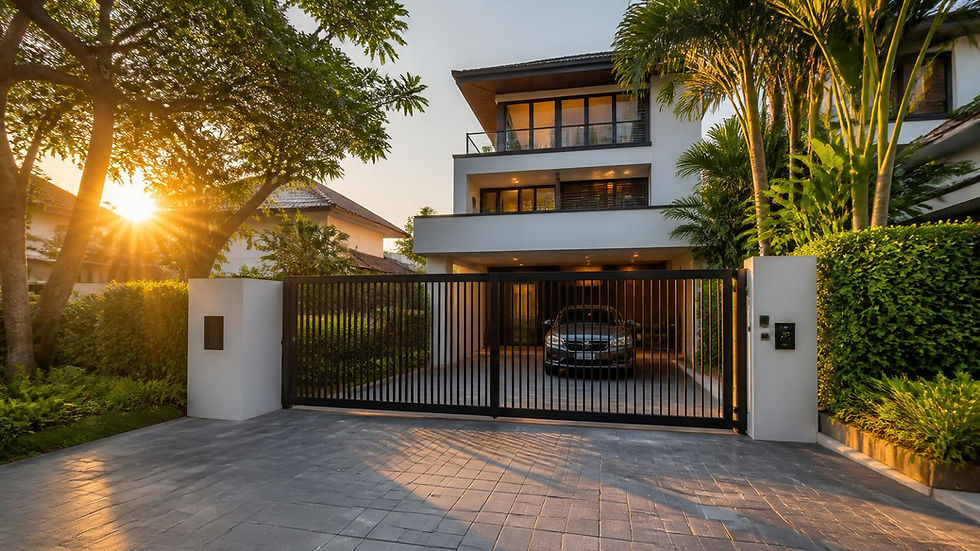
Aluminium Veneer Cladding: Why It's a Hot Facade Choice for Landed Homes


A facade is your home's first impression, and one material has come to define the clean, modern landed-home look: aluminium veneer cladding. Crisp flat panels with slim joints, in almost any colour or finish, have made it a go-to for architects and homeowners alike. Here is why it has become so popular — and the fire-safety rules you must follow before choosing it.

What Is Aluminium Veneer Cladding?
Aluminium veneer cladding (also called solid aluminium panel, or 铝单板) uses single-skin aluminium panels, typically with a durable powder-coat or PVDF/Kynar coating, fabricated to size and fixed to a sub-frame fixed off the wall. It is distinct from aluminium composite panel (ACP), which sandwiches a core between two thin aluminium skins — a difference that matters a great deal for fire safety, as we explain below.
Solid Aluminium vs ACP vs Honeycomb: Know What You're Buying
"Aluminium cladding" covers three very different products, and the differences decide price, flatness and fire safety:

Solid aluminium veneer (铝单板) — one solid sheet, CNC-folded into a tray and coated. The facade standard is 2.5mm AA3003 alloy (also 2.0–4mm; AA1100 pure or AA3003). Fully metal, so it is non-combustible (Class A2). The most rigid, most durable and safest choice for a home facade.

Aluminium composite panel (ACP / 铝塑板) — a 3-layer sandwich, typically 4mm, with two thin 0.5mm aluminium skins over a plastic core. Lighter and cheaper, but the core is the issue. Early ACP was not fire-rated; modern fire-rated (FR / 阻燃) ACP adds flame-retardant filler to meet fire codes. A plain PE core does not belong on a facade.

Honeycomb aluminium (蜂窝铝板) — an aluminium honeycomb core between two skins. Exceptionally flat for large panels and premium-priced; used where a perfectly flat large format matters.
For most landed homes, solid 铝单板 is the sweet spot: non-combustible, rigid and durable.
Why It's a Hot Choice
Sleek modern look — large flat panels, slim joints and a huge range of colours and finishes, including wood-grain and metallic.
Excellent durability in our climate — quality coatings resist Singapore's sun, rain and humidity without rotting, warping or fading.
Very low maintenance — a rinse keeps it clean, with no repainting like a plastered wall.
Lightweight and design-flexible — it can wrap curves, be perforated into screens, and be cut into custom shapes.
Fast, dry installation and a ventilated rain-screen effect that helps the wall shed heat and moisture.
Aluminium Veneer vs ACP vs Plaster & Paint
Plaster and paint is the most economical facade, but it needs repainting, shows algae and can crack over time.
ACP is light and cost-effective but contains a core — a fire concern if that core is combustible.
Solid aluminium veneer sits at the premium end: more rigid, more durable and, importantly, non-combustible, which is increasingly the deciding factor.
The Fire-Safety Rules You Must Follow
Singapore regulates external wall finishes through the SCDF, and after global concerns about cladding fires the rules are strict: cladding used on facades must meet the required fire classification and be tested and certified, with a Certificate of Conformity (valid for five years) from an accredited body.
Solid aluminium panels are non-combustible, which is a real advantage over ACP that uses a combustible core. Whatever you choose, insist on certified, compliant products and a proper installer, and confirm SCDF compliance for your project.
Reading the Fire Certification
When a supplier says "fire-rated," ask which material and which standard:
Solid aluminium (铝单板) is rated Class A2 — non-combustible. It sidesteps the core problem that caused overseas cladding fires, which is why it is the safer default.
ACP depends entirely on its core. Only certified fire-rated (阻燃) grades are acceptable on a facade — get the core's fire certificate specifically, not just the brand name.
In Singapore, external cladding must meet SCDF fire requirements and carry valid certification — a Certificate of Conformity from an accredited body, typically valid five years (check it is current). Look for non-combustible / limited-combustibility classes (e.g. A2-s1, d0).
Confirm the final spec with your architect and the SCDF submission for your project — non-negotiable for a home you live in.
Coatings: Fluorocarbon (PVDF) vs Polyester
The coating is what survives Singapore's sun and rain, so insist on the right one:
Fluorocarbon / PVDF (氟碳漆) — the standard for outdoor facades. Strong UV, weather and pollution resistance; resists fading and chalking for the long term. Sold as two-coat / three-coat (三涂两烤) systems — primer, colour coat, and on three-coat an extra clear coat — with a total film thickness of about 40–60 microns. More coats means better durability.
Polyester (聚酯漆) — harder and cheaper with bright colour, but weaker UV resistance; fades faster outdoors. Acceptable for shaded or secondary areas, not a main sun-facing facade.
Ask the supplier to state the coating type, number of coats and film thickness (microns) in writing — "aluminium cladding" alone tells you nothing about how it looks in five years.
Getting It Right
Use a quality PVDF/Kynar coating for long-term colour retention.
Specify a properly engineered sub-frame and a ventilated cavity behind the panels.
Detail corners, openings and drainage carefully to keep water out.
Use certified, non-combustible panels and an experienced installer.
Allow for thermal movement so panels stay flat over time.
Fixing Systems & Why Panels Stay Flat
How the panels attach affects both the look and whether they stay flat in our heat:

Cassette / hook-on (扣盖/挂件系统) — panels are folded into trays and hooked onto a concealed sub-frame, with no visible fasteners. The key advantage: the panel can expand and contract on all four sides, which relieves thermal stress and prevents the warping (oil-canning) that plagues cheaper systems. Easy to remove a single panel later for repair. The right choice for a quality home facade.
Exposed-fastener / riveted (胶缝外露/钉接) — panels are riveted or screwed straight to the frame (rivets at about 100–150mm spacing; screws to the frame at about 500mm). Cheaper and faster, but fasteners show, panels are harder to swap, and with no room to release thermal stress they are more prone to warping under direct sun.
Both sit on an engineered sub-frame — steel section, light-gauge steel, aluminium, or (less ideal) timber (龙骨) — set off the wall to form a ventilated cavity that lets the wall shed heat and dry out behind the panels.

Where It Works Best on a Landed Home
You do not have to clad the whole house. High-impact uses:
Feature walls and the entrance — a cladding band lifts the front elevation without cladding everything.
Upper-storey boxes and cantilevers — crisp panel lines suit modern massing.
Perforated screens (冲孔铝单板) — privacy, sun-shading, or wrapping a staircase / AC ledge while letting air through.
Soffits and fascias — clean undersides that weather far better than plaster.
Wood-grain finishes — the timber look with none of the rot, warping or termite risk of real wood in our climate.
A cost-smart approach is to mix materials: aluminium veneer where it earns its keep, plaster-and-paint elsewhere.
Common Mistakes to Avoid
Choosing cheap combustible ACP for the look without checking fire compliance.
Specifying a low-grade coating that fades or chalks within a few years.
Poor sub-frame or detailing, leading to water ingress or visible panel waviness (oil-canning).
Ignoring movement and fixing, so panels distort under the sun.
Frequently Asked Questions
Is aluminium cladding allowed on Singapore homes?
Yes, provided the cladding meets Singapore's fire-safety requirements for external wall finishes and is certified. Solid aluminium veneer panels are non-combustible, which helps; always confirm SCDF compliance for your specific product and project.
Aluminium veneer or ACP — which is safer?
Solid aluminium veneer is non-combustible, while ACP depends entirely on its core — a combustible core is a fire risk. For safety and durability, solid aluminium veneer is the stronger choice; if ACP is used, it must be a certified non-combustible grade.
Does aluminium cladding fade, and is it costly?
With a quality PVDF coating it resists fading for many years. It costs more than plaster and paint up front, but its durability and near-zero maintenance often make it worthwhile over the life of the facade.
This article is general guidance for Singapore homeowners, not professional advice. Fire-safety rules and product certifications change over time — confirm SCDF requirements and product compliance with your architect and supplier before specifying any cladding.
Planning Your Landed Home Rebuild?
A landed rebuild rewards careful planning and the right team. Hitomo Construction guides Singapore homeowners through feasibility, design, regulatory submissions, construction and handover — so every decision is made with the full picture in front of you.
Reach out for a no-obligation discussion. Contact Hitomo Construction today to get started.