
Rainwater Harvesting & Sustainable Water Systems for Landed Homes in Singapore

With Singapore's heavy, year-round rainfall and a strong national focus on water sustainability, rainwater harvesting is an increasingly popular feature in landed rebuilds. Captured rainwater can cover many non-potable needs, easing demand on treated water and trimming your monthly bill — and because it is largely a matter of pipes, tanks and a pump, it is far cheaper to design in during construction than to retrofit later.

What You Can Use Harvested Rainwater For
Garden and landscape irrigation — usually the biggest single use.
Washing cars, driveways and outdoor areas.
Toilet flushing, via a separate, clearly labelled non-potable pipe network.
Topping up water features and, in some designs, cooling-tower or pool make-up.
How a System Works
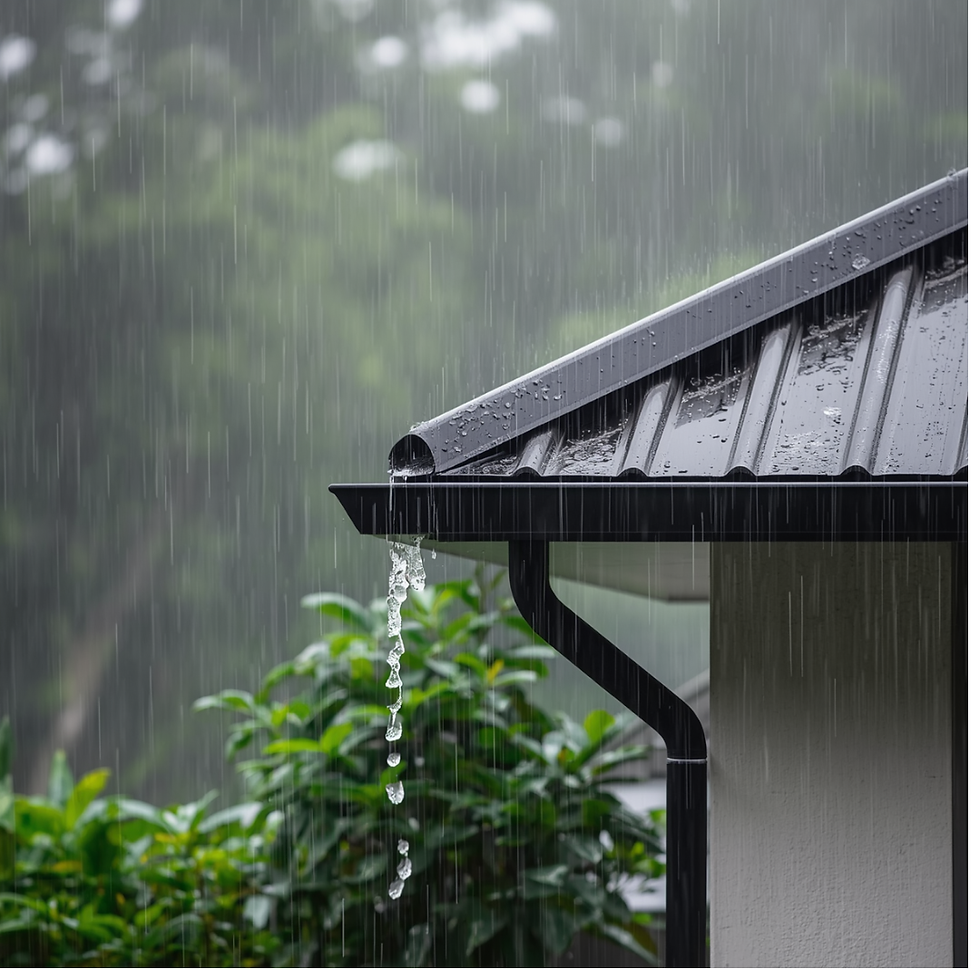
Rainwater runs off the roof into gutters and downpipes, passes through a first-flush diverter and filter to remove leaves and debris, and collects in a storage tank — above ground or buried below the driveway or garden. A pump then distributes it to the points of use. For toilet flushing, a completely separate, marked pipe network keeps non-potable water rigorously apart from the drinking-water supply, with the mains top-up arranged so the two can never cross-connect.
Sizing the Tank
Tank size should be matched to two things: your roof catchment area (more roof equals more capture) and your intended uses (irrigation-only needs less than irrigation-plus-flushing). An oversized tank wastes money and space; an undersized one runs dry in a dry spell. Your designer estimates a sensible capacity from your roof area and typical demand, and locates the tank where its weight and access are easy to accommodate — which is far simpler to do before the driveway and landscaping are built.
Designing It Into the Rebuild
The ideal time to plan a rainwater system is during the rebuild, when tank position, pipe routing, the pump location and power supply can all be designed cleanly and hidden. Retrofitting later means opening finished walls, floors and driveways. Even if you stage the installation, running the pipework and leaving a tank provision now avoids costly rework.
Is It Allowed? The Rules in Singapore
Rainwater harvesting is permitted for landed homes, but it is regulated — you cannot simply plumb a tank into the house. The system must be approved by PUB before construction, designed and submitted by the right Qualified Person, and built so that rainwater can never reach your drinking-water supply. Who must design and submit it depends on how the water moves:
Professional Engineer (Civil) — if rainwater is collected or discharged by gravity.
Professional Engineer (Mechanical) — if collection or discharge involves pumping.
Licensed Plumber — for all Water Service Installation works (and the metering arrangements if your tank exceeds 350 m³, which a typical landed home will not).
Your QP prepares the technical write-up and drawings and submits them to PUB; the standard processing time for a complete submission is around 14 working days.
Keeping the Two Supplies Apart
The non-negotiable safety rule is that non-potable rainwater can never mix with your potable (or NEWater) supply. The Guidance Notes are specific about how this is achieved:
No interconnection or cross-connection between potable and rainwater pipes — they are entirely separate networks.
A vertical air gap of at least 150 mm between any back-up mains top-up discharge point and the top of the rainwater tank.
Double check valves installed at the tee-off of any potable pipe that serves the system.
Colour-coded non-potable pipes and fittings, distinct from potable ones, marked at intervals with "Non-potable water" and "Not for drinking" — with matching signage at every point of use.
This is precisely why the work goes through a licensed plumber and a QP, not a general handyman.
Mosquito-Proofing Is Mandatory
Every system must be mosquito-proofed to NEA's requirements so it cannot become an Aedes breeding ground — sealed/covered tanks, mesh screens, and no open standing water. This is not optional polish: the anti-mosquito measures form part of the technical write-up PUB needs to approve the system.
Maintenance and Drought Rules
Two ongoing obligations are easy to overlook:
A maintenance SOP — owners must maintain the system to a Standard Operating Procedure submitted with the application, covering tank washing and inspection of the accessories.
A drought bypass — during an excessive drought, PUB can direct owners to stop using collected rainwater, so every system must include a bypass that channels rainwater straight to the public drains when ordered.
Planning Your Landed Home Rebuild?
A landed rebuild rewards careful planning and the right team. Hitomo Construction guides Singapore homeowners through feasibility, design, regulatory submissions, construction and handover — so every decision is made with the full picture in front of you.
Reach out for a no-obligation discussion. Contact Hitomo Construction today to get started.


